Poitier Film School filmmaker, ASU diver wins $5k prize in ReelShort contest
Caleb Liban's winning vertical series competed against top filmmakers
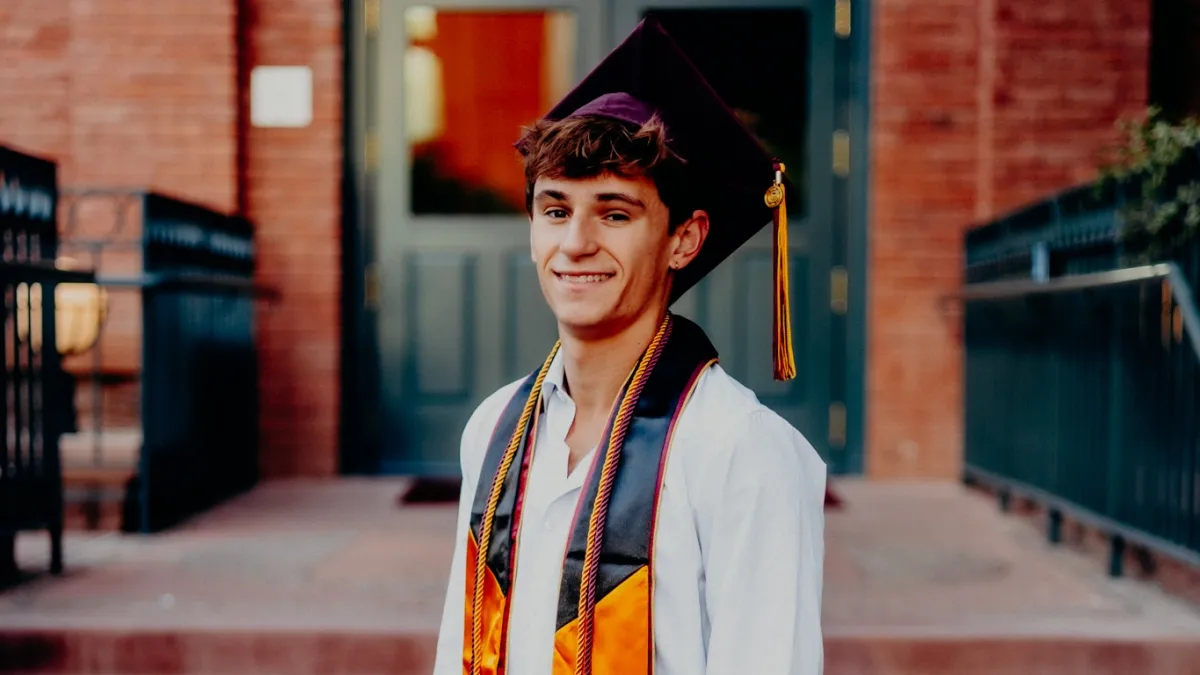
Graduating student filmmaker and athlete Caleb Liban.
Caleb Liban has never shied away from competition. The student filmmaker from Denver, who graduates this spring with a Bachelor of Fine Arts in film and media production and a minor in business, is a competitive diver with the Arizona State University Men’s Swim and Dive team, which placed first at conference for four consecutive years and won a national championship in 2024.
It’s no surprise that when Liban, 21, learned about a film contest in an innovative medium, he’d crush that, too.
Liban won second place (and a $5,000 cash prize) in the recent ReelShort Reel Vertical Impact Contest. Vertical is an emerging medium meant to be watched on smartphones. ReelShort, a short-form-video streaming app, hosts these short films and micro-dramas that, long popular in China, are gaining serious traction in the United States.
When Sidney Poitier New American Film School professors Alex Ma and Horacio Velasquez-Melo told Liban about the contest, he knew his short film, “The Two Man,” would be a good fit.
Though it had been shot in a horizontal format, Liban was able to adapt it to vertical and edit it into a seven-part series (which can be watched on YouTube or ReelShort).
“Caleb's win is significant because he competed not only with students from other top film schools but also with professional filmmakers, demonstrating his talent and adaptability in this evolving landscape,” said Ma, who is working to integrate education about vertical filmmaking into The Poitier Film School curriculum.
Ma is developing an Introduction to Writing for Vertical Filmmaking weekend seminar, making The Poitier Film School among the first in the U.S. to offer dedicated courses on vertical and paving the way for more students to follow in Liban’s footsteps.
“Our faculty are committed to staying abreast of industry trends and introducing relevant opportunities to our students,” Ma said.
A representative from ReelShort commented, “We are thrilled to partner with the ASU film school and celebrate this student success. Caleb’s winning entry was selected from hundreds of submissions in the editing category alone, including entries from Columbia, NYU, USC and other top programs, as well as professional filmmakers with years of experience. We are happy to see Caleb’s work recognized and look forward to continuing our collaboration with ASU.”
Below, Liban shares more about his ASU experience and plans for the future.
Note: Answers may have been lightly edited for length and/or clarity.
Question: Why did you choose The Sidney Poitier New American Film School?
Answer: I was recruited to join ASU’s Division I diving team. At the time, I was considering a couple other schools, but I was ultimately looking for a place where I could simultaneously pursue my dreams of working in film and television. I saw that The Poitier Film School curriculum emphasized film production, and that the professors had plentiful industry experience. ASU was the perfect place to pursue my academic interests and compete at the highest level in my sport.
Q: Would you make more short-form vertical films in the future?
A: I would be very interested in making more vertical films. There is major demand for vertical content; however, the bulk of content is still dominated by memes and smartphone-filmed user-generated content. Successful vertical films require fast pacing and precision, but I think you can still tell compelling stories with high production value. I’m excited to see the quality of vertical content continue to elevate over time.
Q: What’s something you learned in your time at ASU that changed your perspective?
A: One of the most powerful things I learned is that “How you do anything is how you do everything.” This is a frequent quote of the ASU swim and dive staff, as they instill upon us that athletes who succeed in the pool also excel academically. I believe that this applies universally, even beyond that. You need not compromise one priority for another, and I wholeheartedly believe one can balance several commitments and give their all to each of them. In my filmmaking, diving and personal relationships, I push myself 100% of the time and make learning and growth a priority.
Q: What’s next for you, academically or professionally, after graduation?
A: I am actively networking with industry connections and applying for assistant positions and internships in editorial for film, television and sports media. I have also been accepted into a couple graduate programs, including the MA in narrative and emerging media in The Poitier Film School based in Los Angeles. (Note: The NEM program is shared with the Walter Cronkite School of Journalism and Mass Communication.)
Q: If you were given a blank check to fund a creative project, what would you make?
A: I have a passion for comedy and would definitely create a film/vertical series in that genre. I am also writing a dark-comedy feature film script in class that I would be thrilled to produce one day!