A long trip back home
After 45 years away, Randy Bennett is, finally, ASU’s men’s basketball coach
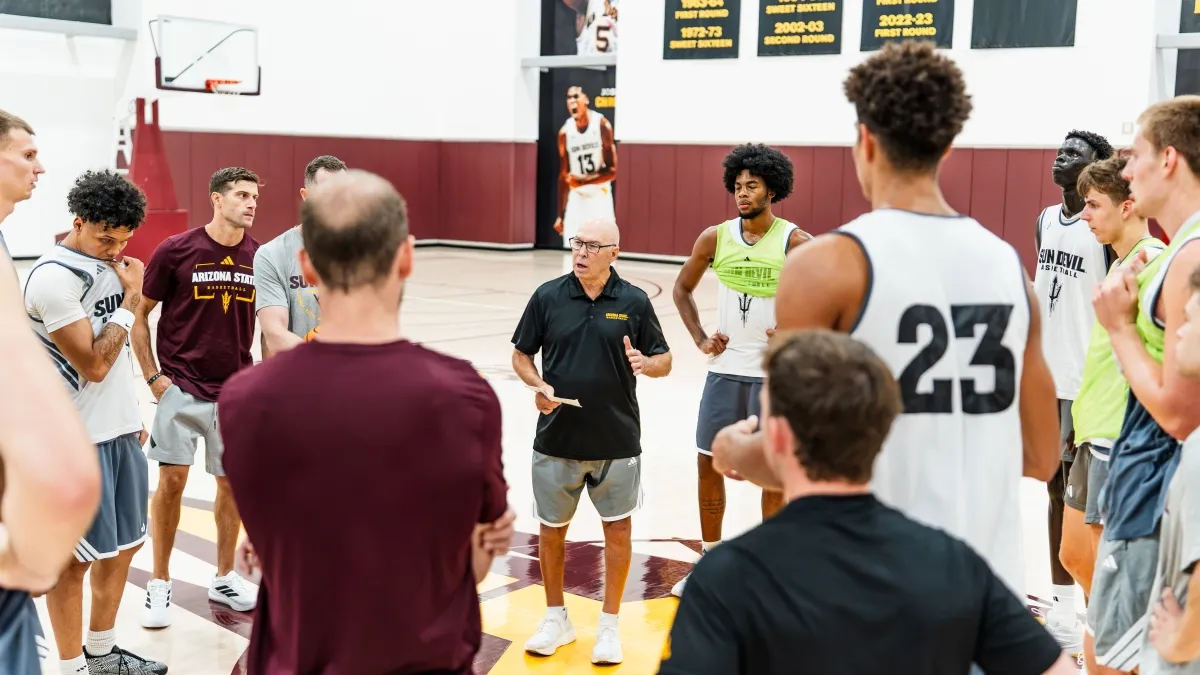
After 25 years coaching at St. Mary’s College of California, Randy Bennett (center) has returned home to coach his beloved Sun Devils as the new Arizona State University men’s basketball coach. Photo courtesy of Sun Devil Athletics
Tom Bennett leans back into the black folding chair as he peruses the day’s practice schedule.
Arizona State University’s men’s basketball team is just finishing an afternoon workout at the Weatherup Center. A player approaches Bennett, presumably recognizing the legendary former Mesa Community College coach, and offers his hand.
They exchange pleasantries, and then Bennett offers some advice, telling the player that when he initiates a spin move around the basket, he’s telegraphing what he’s going to do by the placement of his left hand.
“You don’t have to do what I’m telling you,” Bennett says. “Just trying to help.”
A week later, coach Randy Bennett is told of the conversation. A smile spreads across his face.
“He’s sneaking those in,” Randy says. “Believe me, he’s not running that by me. But you can’t stop him. Once a coach, always a coach.”
The father could say the same thing about the son.
The journey
It took a long time for Randy Bennett to come home.
He grew up just 10 minutes from ASU’s Tempe campus, on Alma School Road and Eighth Street, about a half mile from Mesa Westwood High School, where his basketball DNA began to embed itself and would eventually be a hallmark of the teams he coached.
Randy was a point guard at Westwood. He wasn’t the best shooter or the best athlete. Ask him about the kind of player he was and, in a self-effacing sort of way, he says, “I took a lot of charges.”
Tim Vanda gives his high school teammate a bit more credit than that.
“Randy was a fierce competitor,” Vanda said. “He’s not the tallest guy in the world but I tell you what, he wasn’t afraid to take a foot in the chest from the big man coming down the lane. He did not like to lose. We had some really exceptional teams because of his leadership.”
It’s funny, Vanda said. Those Westwood players have grown up, lived their lives and had families, but when they go out to dinner together as a team — as they did three times in the last year — “Randy is still clearly our leader.”
Randy left Arizona behind after playing at MCC from 1980 to 1982, for his father. Nineteen years later, after a few stops, he became head coach at St. Mary’s College of California.
For a quarter-century, he built one of college basketball’s best mid-major programs. He led St. Mary’s to 12 NCAA Tournament berths and was named the West Coast Conference coach of the year seven times.
By the end of the 2025–26 season, Randy was content to remain at St. Mary’s the rest of his career. He was 63 years old and, in his words, “good there.”
But then the one job he would leave St. Mary’s for opened up. And when the chance to become ASU’s coach came his way, he couldn’t say no.
“I love St. Mary’s,” Randy said. “I gave up some things that are pretty special. But it’s hard to find somebody that cares more about coaching here than me. I really want to do a good job here.”
Back home
Walk into an ASU basketball practice these days, and you’re bound to run into a former Arizona high school coach. One day, it’s Sam Duane, former coach at Tempe Corona del Sol and Gilbert Perry High School. Another day it’s Vanda, who coached at Apache Junction, and Jay Troutt, former coach at Chandler High.
They are Randy’s contemporaries, and as they talk and laugh and joke after practice, daily reminders of why coming home and coaching ASU has been rejuvenating for Randy.
“I told somebody that every week I’m here, I’m happier,” Randy said. “I get to see my coaching friends, and they go deep, and then you count all of my dad’s coaching buddies.
“When I say I’m an Arizona guy, I’m an Arizona guy. I was going to retire here eventually because this is home. But I hadn’t been here in so long. I forgot how many people I knew and had as friends.”
Randy’s affection for ASU runs deep.
Tom Bennett started taking Randy to games in the late 1970s, when the Sun Devils’ backcourt featured future NBA stars Fat Lever and Byron Scott. Randy dreamed of becoming a Sun Devil as well, but when ASU didn’t offer him a scholarship, it was off to UC San Diego.
“I wasn’t going to be a walk-on,” he said.
When Randy looks around Desert Financial Arena, he doesn’t see a building that’s undergoing a makeover. He sees what it could be, if his teams play as consistently well as his St. Mary’s teams, and energized Sun Devil fans fill the seats.
“To be in here to coach and practice, I think it’s a great setup,” he said. “Being here is just fun. Every time we get to practice here, I’m pretty excited.”

It would be a mistake to assume Randy’s return to ASU is about his father and friends, about comfort rather than competition. He is fiercely determined to lift the basketball program because he cares so much about it.
“I think Randy is more excited about this position than he’s been in his entire college career,” Vanda said.
Watch a few of ASU’s practices, and a pattern emerges. Randy’s voice isn’t a constant. He has an experienced staff, many of whom have been his assistants in the past, so he’s comfortable letting them coach. But when he wants to be heard, practices stop and he has the players’ full attention.
“I think his concern for players, his attention to detail and the atmosphere that they created at St. Mary’s, and they’re trying to create here, is exceptional,” Tom Bennett said. “Every practice I’ve been to has been upbeat and they’re working hard all the time.”
It’s no surprise then, that Randy’s coaching style is a direct reflection of his father, who was Mesa Community College’s head coach for 19 years. It is a bit ironic, however. When Randy told his dad that he wanted to become a coach, Tom tried to dissuade him.
“I told him I didn’t know if he should because he would work so hard at it, and I wasn’t sure if he’d find very many players that would put as much work into it as he did,” Tom said. “Shows you how well he listened to me.”
Tom’s teams at MCC were disciplined, hard-working and rarely played zone defense. Man-to-man defense was their calling card. Randy has the same philosophy.
“We don’t zone. We never play zone,” he said.
There are times, too, when Randy hears himself saying the same things Tom did when he was coaching.
“Know your job, do your job and do your job as well as it can be done,” Randy said. “I still use that one. And that’s one that was coming out of MCC in 1981 or 1982.
“That should tell you the influence he had on me.”
Father and son still talk basketball — “I’ll call him about a decision I have to make and ask, ‘What would you do in this situation with your team or your player?’” Randy said — but the truth is, Randy doesn’t need much advice these days. Twenty-five years as a head coach has made him pretty secure.
“I know what I’m going to do,” he said. “I’m not going to change too much.”
It’s nearly 6 p.m. on a Tuesday. Practice is over. The players have headed out the door, and Desert Financial Arena is quiet.
Randy looks around. At the arena he once hoped to play in. At the arena he can now, finally, call home.
“I wasn’t planning on ever being here,” he said. “I just don’t usually think that way, like something is going to work out. I wasn’t hoping for that at all.
“But sometimes, things work out. I was lucky.”
