How the ‘Homeboys’ and 3-a-day practices led to a Rose Bowl win
An oral history of the 1986 ASU football team that beat Michigan in the Rose Bowl
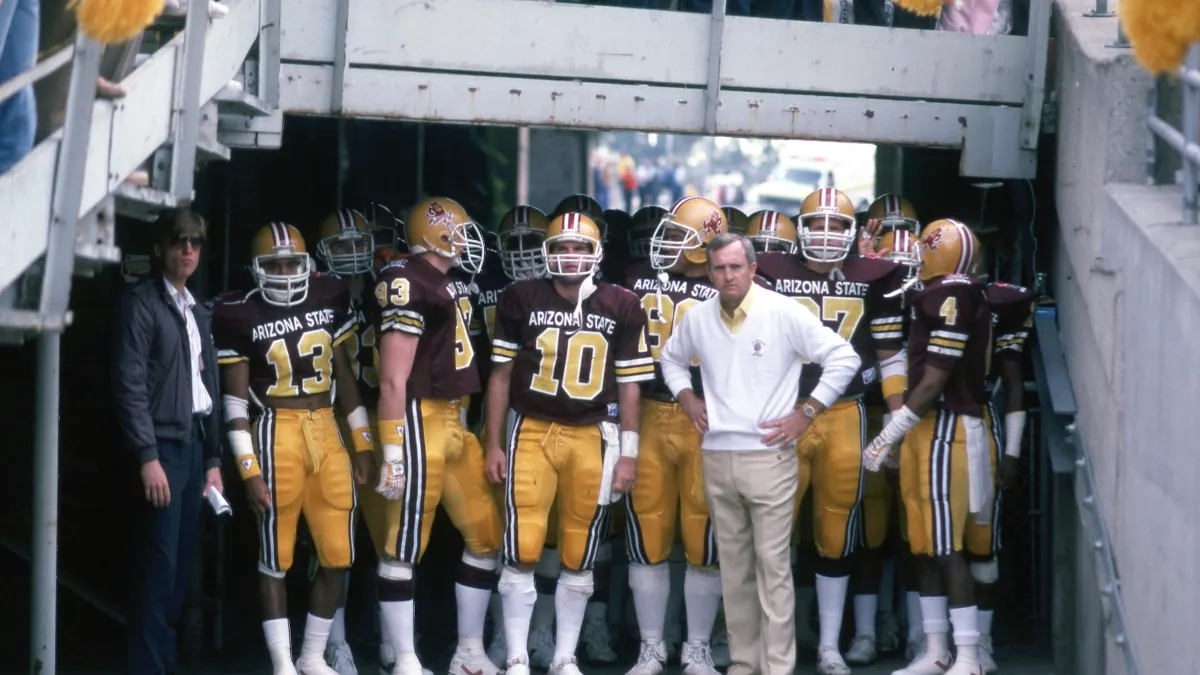
Coach John Cooper stands with quarterback Jeff Van Raaphorst (10) and the rest of the Sun Devils before walking onto the field at the 1987 Rose Bowl against Michigan. Photo by Greggory Gerlach/ASU
Mike Martz was a football coach for 46 years, his resume a collection of stops from high school to the NFL.
He coached bad teams. He coached good teams. But those special teams, the ones he can never forget? They shared a common characteristic.
“There’s just a different vibe, if you will,” Martz said. “There’s just a different cohesion between the players and a toughness and commitment where everybody just kind of gels. It’s a special place and time. And you know you’re in it at the time and want it to last as long as you can.”
Martz counts the 1999 St. Louis Rams that won the Super Bowl — Martz was offensive coordinator under Dick Vermeil — as one of those teams.
And he includes a team celebrating its 40th anniversary this year: the 1986 Arizona State Sun Devils squad that finished 10-1-1, beat the University of Michigan in the Rose Bowl and ended the season ranked No. 4 in the Associated Press poll.
“That season,” said Martz, then ASU’s quarterbacks coach, “brings back a lot of great memories.”
ASU News spoke with 11 coaches and players from the ’86 team. With smiles on their faces, they spoke of a Rose Bowl sideline boast from the most unexpected of voices, a film projector that flew through the air and five large young men known as the “Homeboys.”
This is their story.
The Sun Devils were coming off a 1985 season in which they finished 8-4 and would have gone to the Rose Bowl had they not been upset by the University of Arizona, 16-13, in the regular season finale.
ASU’s roster was deep and supremely talented; 18 players would go on to play at least one game in the NFL, including two Pro Football Hall of Fame members in offensive lineman Randall McDaniel and cornerback Eric Allen.
Head coach John Cooper: I’ve been coaching all my dang career, and that team is about as good as any I’ve coached, to be honest. It was a great team. We had a good quarterback (in Jeff Van Raaphorst), a great defense and Randall McDaniel was about as good an offensive lineman as I’ve seen in college football. Really great coaches and really great players.
Van Raaphorst: I remember riding to San Diego in the summer with Eric Allen, and we stopped in El Centro and got one of those old Athlon magazines. They picked us to finish like, fifth in the Pac-10, and we were hot. I don’t think we talked from El Centro all the way to San Diego, which is about 120 miles. It just kind of shows you that it’s not about the outside noise there. It’s what the guys in the locker room say.
Recruiting coordinator Don Bocchi: I saw (defensive back) Darren Willis last spring and I said to him, “Darren, before you had to tackle somebody, they had to run through five or six NFL players before they got to you.”
Offensive lineman Jim Warne: We beat five ranked teams. And we were the first ASU team to beat USC and UCLA on the road in the same season.
Defensive end Trace Armstrong: I knew we would be good, and you just assumed that we were going to take the next step. So yeah, I thought for sure that we would be in the Rose Bowl discussion.

Cooper, in his second year coaching the Sun Devils, was a demanding presence, from the way he expected players to act during film sessions to what he wanted from his assistant coaches during practices. At Camp Tontozona, ASU practiced three times a day.
Armstrong: Really, from the minute coach Cooper got there, he got everybody’s attention.
Tight end Stein Koss: One of the first meetings we had, some guys were kind of kicking back in their chair with their hat on backwards. He said, “Nope, we’re not doing that here. Sit up straight and take your hat off.”
Warne: He came in and just said, “I don’t know how many games we’re going to win but we’re going to be the most in-shape team in the Pac-10.” And, pretty quickly, we were running all the way up to the top deck of the stadium.
Armstrong: If you didn’t know what you were supposed to be doing, we’d have what you would call a “memory builder,” which was a gasser the width of the field. Coach Cooper would be like, “Mr. Armstrong needs a memory builder,” but the whole team had to run it. After practice, coach would be walking around and he’d say, “What was the last play we ran?” If you said, “I don’t know,” he’d be like, “Why don’t you know? Weren’t you getting a mental rep watching that play?” So that would be another memory builder.
Martz: I was never part of a staff where we were as intense and detail oriented as we were with John Cooper. There was no clowning around. When you were at work, you were at work. And he would peek over your shoulder in drills to make sure they were executed properly. And if it wasn’t done up to snuff, you got a talking to. It was good because it made everybody accountable. And when the coaching staff is accountable, then players are accountable.
Cooper: I was one of those head coaches that let coaches coach, but they coached the way I wanted them to coach. It used to make me so mad to hear a coach say, “Tackle.” It’s your job to teach them how to tackle. It’s your job to teach them to catch the ball. That’s all we talked about. Fundamentals. Fundamentals.
Cornerback and punt returner Anthony Parker: When we heard we were doing three-a-days at Tontozona, we were like, “What do you mean? Two-a-days aren’t hard enough?” But it bonded us because we were all like, “What the hell are we doing?”
Koss: It was a grind. I remember lying in bed saying, “How the hell am I going to get to practice?” because I was so beat up and tired.
After arriving back in Tempe to start fall camp, the players decided they had had enough. If the coaches weren’t going to give them a day off, they decided, they would take it themselves.
Van Raaphorst: UCLA had pulled a thing called “the wall” with (coach) Terry Donahue. They were just beat up from having too many practices a day. So during stretching, they started clapping. Then they just left, jumping the wall at the practice field. ... So I remember walking in the locker room around Labor Day. We had just come back from Tontozona. We were just gassed. Guys were beat up. ... Guys were like, “We’re going over the wall today. We’re going to vote whether to boycott.” ... We decided only juniors and seniors were going to get votes. I’m thinking, “This is not going to go over well.” But I was a captain, so I said I would tell (coach Cooper).
Martz: We were in the shower, and somebody came in and said, “I think the players want to boycott or something.” John (Cooper) didn’t want to talk to them. He sent (defensive coordinator) Larry Marmie and (offensive coordinator) Jim Colletto. Larry, when he is hot, when he’s intense, those eyes kind of come out of his head a little bit.
Van Raaphorst: They walk into the room and, boy, it’s quiet. ... The next thing I know a projector flies across the room and hits the wall.
Marmie: It might have been some part of the projector. A remote control might have slipped out of my hand.
Van Raaphorst: Larry says, “Let me tell you what we’re going to do. You are not going to come in here and tell us what we are going to do. You’re going to be on the practice field in 20 minutes.” So we come running out of the coaches’ room and all of the freshmen and sophomores are sticking their heads out like a bunch of little raccoons on a tree. They asked, “What happened?” (I said), “What happened? Get your stuff on. We got 12 minutes.” I mean, it was brutal, and we paid for it, too.
The Sun Devils cruised through the early part of their schedule, the only blip being a 21-21 tie against Washington State, a game in which Van Raaphorst threw five interceptions.
On Nov. 8, they beat California, 49-0, to clinch the Pac-10 championship and a berth in the Rose Bowl. It was the first time an Arizona school had won the conference since ASU and Arizona joined the Pac-10 in 1978.
National media attention started coming the Sun Devils’ way, and Sports Illustrated ran an article by Rick Reilly titled “Coming out of the Desert Darkness with the Sun Devils.” The article highlighted the offensive line, nicknamed the “Homeboys” because all five starters — Todd Kalis, McDaniel, Kevin Thomas, Danny Villa and Warne — were in-state products.
Van Raaphorst: That group was so tenacious. They were all super competitive and athletic. And they were really good people, too.
Martz: That offensive line was probably as good as there was in college football. I think they epitomized the physicality of the football team that came from coach Cooper. He was always talking about doing the right things and being physical, and that’s the way that line played.
Warne: We all had met through track and field in high school. Or powerlifting events. We became buddies. Then, in 1986, when we got into the top 10, we got that initial Sports Illustrated article written about us, and that’s where the “Homeboys” nickname was born. We didn’t have a nickname for ourselves, but during the interview we were just looking at each other and I went, “Well, how about the Homeboys?” We all went, “Yeah, that sounds good.”
After clinching the Rose Bowl berth, ASU beat Wichita State, 52-6, setting up the annual Territorial Cup rivalry matchup against Arizona, ranked No. 14 in the country. The Sun Devils lost, 34-17, in a game defined by the 106-yard interception return for a touchdown by Wildcats safety Chuck Cecil.
Koss: I still have nightmares about that game.
Bocchi: We were mentally ripe to be upset. Guys were worried about everything but the game. They were thinking about what kind of bowl gifts they were going to receive. The last thing on our mind was playing Arizona.
Martz: We were riding the bus down to Tucson the day before the game, and the talk on the bus was about what the Rose Bowl rings were going to look like. ... I was so angry when I got off the bus. I said to somebody, ... “Man, I didn’t like that ride.” But we didn’t say anything. And that’s our fault. We didn’t get the players ready.
Van Raaphorst: What really bothered me is that we switched hotels and got a nicer hotel. I remember walking into the hotel and saying to somebody, “We never stay at nice hotels. This is just weird.” A couple of guys even jumped into the jacuzzi. Looking back on it, I don’t know why we would’ve switched hotels. It just had a different feel. The other thing that happened is that Penn State and Miami both went undefeated and would play for the national championship. We had no shot. But, you know, it’s all excuses. At the end of the day, you can’t lose to UA. And we did.
Marmie: I didn’t see that coming. That’s the way I’ll put it. I didn’t see that coming.
With the disappointment of the Arizona loss still lingering, the Sun Devils arrived in Pasadena two weeks before the Jan. 1 Rose Bowl against No. 4 Michigan. Determined to make sure ASU played up to its capabilities, Cooper held two-a-day practices the first week, an unheard-of workload that late in the season.
Armstrong: We literally beat the crap out of each other. I’m not kidding. It was training camp intensity. Full goal-line drills. All of it.
Parker: Obviously, (Cooper) was trying to drive home a point. We were riding pretty high going into the Arizona game. There may have been a little bit of a letdown. So I’m sure coach Cooper was like, “Listen, we can’t have this in one of the biggest games we’ll ever play in.” It was back to the basics, back to getting all the fundamentals down and all that kind of stuff.
Koss: It was pretty genius on coach’s part. We didn’t have any curfew the first five or six days we were there, so we’d go out and have a few beers and be hurting a bit. They said to us, “You earned the right, but we have practice at 8 a.m. and you have to be taped up and ready to go at 6 a.m. for film study.” There weren’t a lot of us going out after that.

ASU was a two-and-a-half point underdog in the Rose Bowl to Michigan, one of college football’s blue blood programs. And the first half played out that way, with Michigan taking a 15-13 lead. But on the Sun Devils’ sideline, there was a deep-seated belief that they would run over Michigan in the second half and win the game.
Armstrong: I think we might have been intimidated a little bit by the mystique of Michigan. We had a little bit of an inferiority complex, and Michigan was one of the iconic programs in college football history. But once we got out there and started playing them, you were like, “OK, we can take these guys.”
Martz: I remember Randall McDaniel coming off the field, and he was laughing. I was looking at him and he said, “We’re going to win this game. These guys ain’t nothing. We’re going to win this game.” It was so unusual to hear that from Randall. He wasn’t the boastful type.
Bocchi: I still vividly remember at halftime, (defensive lineman) Jim Reynosa coming into the locker room and saying, “Fellas, this game is over.” I asked him why. He said, “Coach, when you hit them, they just go ‘oof.’” He said they’re not in shape and we could do whatever we wanted. And it was pretty much true from that point on.
At halftime, Cooper told Van Raaphorst to go up-tempo with the offense. The decision immediately paid dividends. ASU took the opening kickoff of the second half and went on an 80-yard drive, capped by a 1-yard touchdown pass from Van Raaphorst to wide receiver Bruce Hill.
The Sun Devils didn’t commit a single turnover or give up a sack in the game, the defense held Michigan scoreless in the second half, and ASU won, 22-15. Van Raaphorst was named the game’s most valuable player after throwing for 193 yards and two touchdowns. The players carried Cooper off the field.
Cooper, after the game: I’m on cloud nine. I don’t even want to sit down. It’s the greatest win I’ve ever been associated with, my greatest thrill as a head coach.
Forty years later, the memories are precious, of a team that made school history and a group of young men that became, in a real sense, brothers.
Parker: A lot of us are still in touch with one another. I think about how close we are. At the time, you love hanging out, but you have no idea you’re still going to be hanging out this late in life. There’s just this camaraderie. I can truly say that was probably the closest group of guys that I’ve ever been around, on any team I ever played on. We’ve stuck together through all kinds of times. People passing, weddings, grandkids, you name it. We still know what’s going on in each other’s lives. It’s pretty special.